

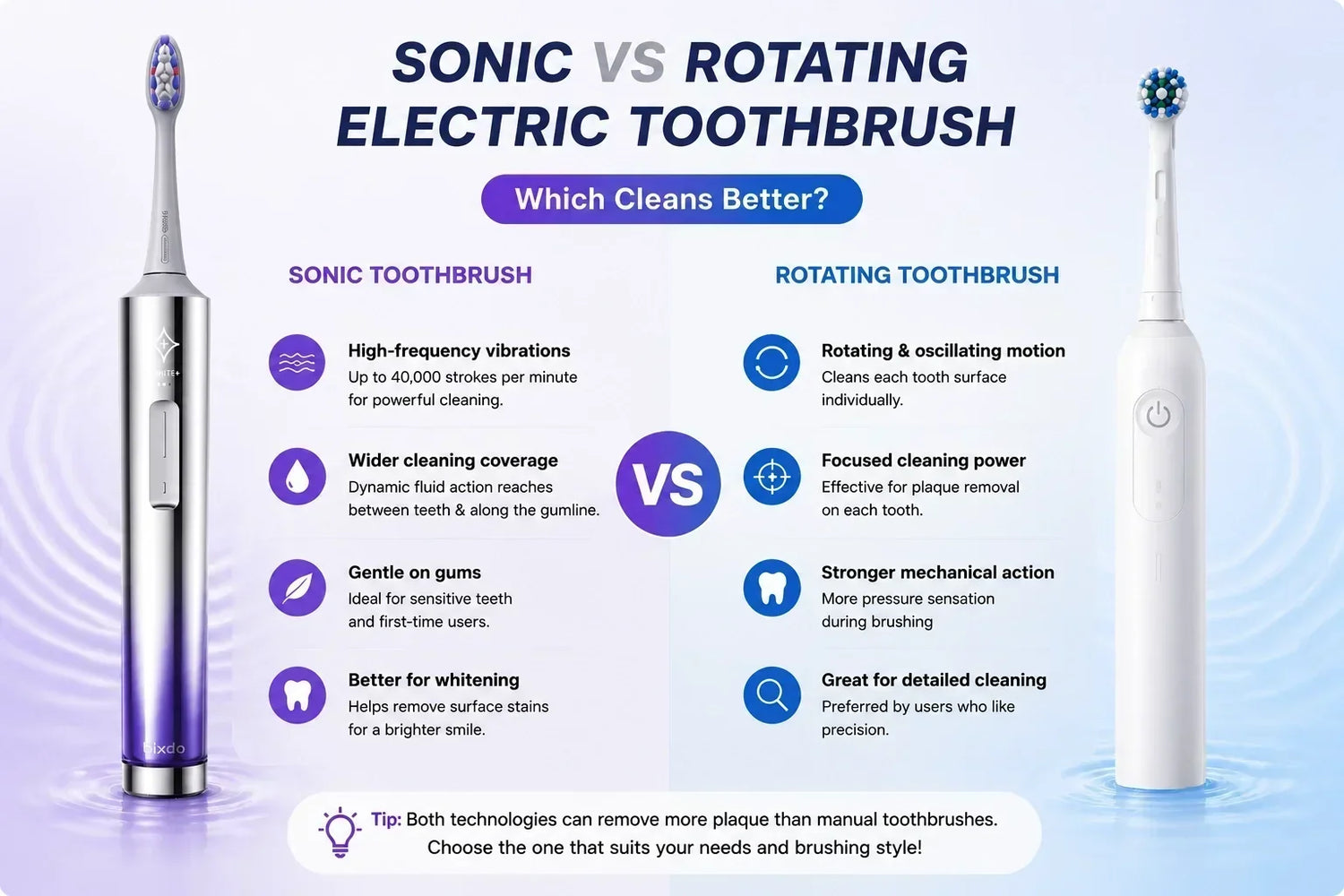
Sonic vs Rotating Electric Toothbrush: Which Cleans Better?
Introduction
Choosing an electric toothbrush can be confusing.
Most electric toothbrushes use one of two technologies:
- Sonic vibration technology
- Rotating oscillation technology
Both claim to provide deeper cleaning than a manual toothbrush, but they work differently.
So which one actually cleans better?
The answer depends on your brushing habits, gum sensitivity, whitening goals, and cleaning needs.
In this guide, we compare:
- Cleaning mechanism
- Plaque removal
- Whitening performance
- Gum comfort
- Battery life
- User experience
1. How Sonic Electric Toothbrush Works
High-frequency vibration technology
Sonic toothbrushes use rapid side-to-side movements to create thousands of brush strokes per minute.
Example:
- Brush head moves back and forth
- Creates fluid movement around teeth
- Helps clean areas beyond direct bristle contact
Typical features:
| Feature | Sonic Toothbrush |
|---|---|
| Movement | High-frequency vibration |
| Brush head | Usually elongated |
| Cleaning area | Teeth + surrounding areas |
| Feeling | Gentle, smooth |
2. How Rotating Electric Toothbrush Works
Oscillating rotating technology
Rotating toothbrushes use a round brush head that rotates and oscillates around each tooth.
Movement:
- Rotates clockwise
- Rotates counterclockwise
- Cleans tooth surfaces individually
| Feature | Rotating Toothbrush |
|---|---|
| Movement | Circular rotation |
| Brush head | Round |
| Cleaning method | Tooth-by-tooth cleaning |
| Feeling | More mechanical |
3. Sonic vs Rotating: Cleaning Performance Comparison
Plaque Removal
Both technologies can significantly improve plaque removal compared with manual brushing.
However:
Sonic toothbrush advantage:
Because of high-frequency vibration:
- Covers larger surface area
- Creates dynamic fluid movement
- Requires less precise brushing technique
Rotating toothbrush advantage:
Because the head physically rotates:
- Provides focused cleaning
- Can be effective for users who need guided brushing
Comparison:
| Sonic | Rotating | |
|---|---|---|
| Plaque removal | ⭐⭐⭐⭐⭐ | ⭐⭐⭐⭐⭐ |
| Coverage area | Better | Moderate |
| Precision cleaning | Moderate | Better |
| Beginner friendly | Better | Good |
4. Which Is Better for Whitening?
For whitening-focused users:
Sonic toothbrushes may have advantages because:
- Higher brushing frequency
- Better coverage between teeth
- Compatible with whitening toothpaste
- Helps remove surface stains caused by coffee, tea, wine
Recommended for:
☕ Coffee drinkers
🍷 Wine drinkers
🚬 Smokers
✨ Users wanting brighter smiles
5. Which Is Better for Sensitive Teeth?
Sonic toothbrush
Better for:
- Sensitive gums
- First-time electric toothbrush users
- People who prefer gentle brushing
Rotating toothbrush
May feel stronger because:
- Direct mechanical movement
- More pressure sensation
Winner:
Sensitive gums → Sonic
6. Sonic vs Rotating Toothbrush: Pros and Cons
Sonic Toothbrush
Advantages:
✓ Larger cleaning coverage
✓ Gentle vibration
✓ Easier brushing technique
✓ Better whitening experience
Disadvantages:
× May feel unusual at first
× Usually higher price
Rotating Toothbrush
Advantages:
✓ Strong mechanical cleaning
✓ Excellent tooth-by-tooth cleaning
✓ Familiar brushing feeling
Disadvantages:
× Requires more movement guidance
× Smaller cleaning coverage
7. So Which Electric Toothbrush Should You Choose?
Choose Sonic if you:
✔ Want whitening benefits
✔ Drink coffee regularly
✔ Have sensitive gums
✔ Prefer gentle cleaning
✔ Want easier daily brushing
Choose Rotating if you:
✔ Prefer strong mechanical cleaning
✔ Like precise tooth cleaning
✔ Are comfortable with round brush heads
Final Verdict
There is no single winner for everyone.
However, for most everyday users:
A sonic electric toothbrush provides a more comfortable, efficient, and user-friendly cleaning experience.
Especially for users who care about:
- whitening
- stain removal
- gum comfort
- long-term oral care

Leave a comment
This site is protected by hCaptcha and the hCaptcha Privacy Policy and Terms of Service apply.