

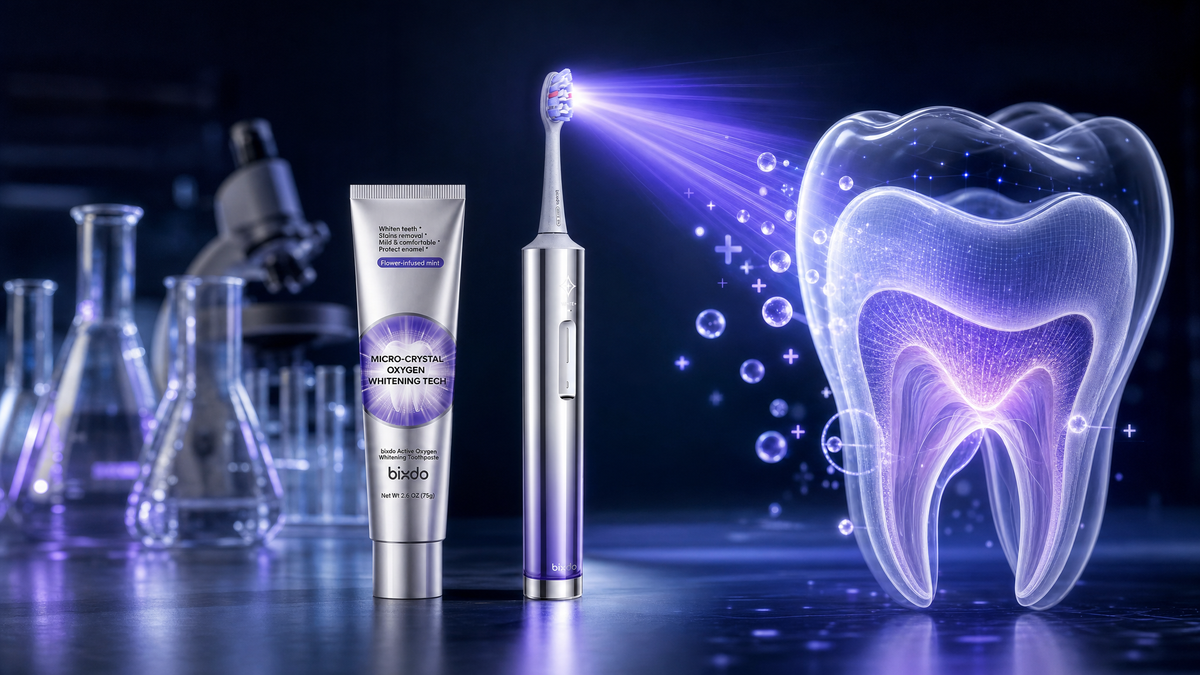
Do Blue-Light Teeth-Whitening Toothbrushes Actually Work?
The research is not a clean “yes” or “no.” Some laboratory studies show that particular blue-light protocols can affect stain molecules or enhance certain whitening agents. Broader clinical reviews, however, have not found that adding light consistently improves final whitening results across in-office bleaching treatments. Newer research on PAP formulas also shows that an LED benefit cannot be assumed for every product.
That makes the most consumer question more specific: Does this complete blue-light toothbrush system have evidence for the result it promises?
“Blue-light whitening” can describe several very different things. One product may place a small blue LED near the teeth without pairing it with a meaningful whitening active. Another may use light with hydrogen peroxide, carbamide peroxide, or PAP. A third may have a light-delivery design and a toothpaste created to work as one routine.
Those products should not be treated as scientifically interchangeable. A wavelength printed on a package tells you only one part of the story. It does not tell you how much light reaches the tooth, for how long, how consistently it is delivered, whether the whitening formula absorbs or responds to that light, or whether real users saw a meaningful result.

There is also a language problem. People often use “whitening” to describe anything that makes teeth look cleaner or brighter. In research, however, removing fresh surface stain, chemically bleaching deeper chromophores, changing yellowness, and producing a durable shade change after the tooth rehydrates are different outcomes. A study can support one without proving all of them.
Why the answer is more complicated than “blue light works”
“Blue-light whitening” can describe several very different things. One product may place a small blue LED near the teeth without pairing it with a meaningful whitening active. Another may use light with hydrogen peroxide, carbamide peroxide, or PAP. A third may have a light-delivery design and a toothpaste created to work as one routine.
Those products should not be treated as scientifically interchangeable. A wavelength printed on a package tells you only one part of the story. It does not tell you how much light reaches the tooth, for how long, how consistently it is delivered, whether the whitening formula absorbs or responds to that light, or whether real users saw a meaningful result.
There is also a language problem. People often use “whitening” to describe anything that makes teeth look cleaner or brighter. In research, however, removing fresh surface stain, chemically bleaching deeper chromophores, changing yellowness, and producing a durable shade change after the tooth rehydrates are different outcomes. A study can support one without proving all of them.

What is blue light supposed to do during whitening?
Blue light is not itself a whitening ingredient. It does not work like a bleach that can simply be painted onto the tooth. Its proposed role is to deliver energy that may interact with certain colored molecules and, in some protocols, help a whitening agent break down chromophores more efficiently.
A 2021 laboratory study by Gottenbos and colleagues tested extracted human teeth with naturally accumulated discoloration. The researchers used 456 nm blue light at 190 mW/cm² with 6% or 25% hydrogen peroxide. Under those specific conditions, the light-and-peroxide combinations produced greater color change than either modality used alone. The authors proposed two parallel mechanisms: direct photobleaching of some chromophores and light-assisted oxidation when blue light and hydrogen peroxide were combined.
That study is useful because it shows that blue light can have a plausible role under a controlled protocol. It does not prove that every blue-light toothbrush works. It used extracted teeth, unusually long cumulative exposure, hydrogen peroxide rather than PAP, and a high-intensity in-office light source. All authors were also employed by Philips at the time, and the tested bleaching products came from Philips Oral Healthcare. Those facts do not invalidate the experiment, but they matter when deciding how far its conclusion can be generalized.

What about PAP and blue light?
PAP, short for phthalimidoperoxycaproic acid, is used in some non-hydrogen-peroxide whitening formulas. Interest in PAP has grown because consumers often want a whitening routine that does not use hydrogen peroxide or carbamide peroxide.
Here again, it is important to separate evidence for PAP from evidence for PAP plus blue light. A 2026 laboratory study compared PAP with and without blue or violet LED irradiation, alongside hydrogen-peroxide groups and light-only controls. In that experiment, PAP did not produce statistically significant bleaching compared with the controls, and adding LED irradiation did not create a significant PAP benefit under the tested protocol. By contrast, 10% hydrogen peroxide produced clearer bleaching, especially with one of the professional light devices.
A different 2026 laboratory study found that the PAP gel it tested did produce a bleaching effect after 14 days, although it was less effective than 10% carbamide peroxide. That study evaluated PAP as part of a particular commercial formula; it did not isolate a blue-light contribution.
These findings may sound contradictory, but the tested products and protocols were different. PAP concentration, pH, supporting ingredients, application time, stain model, and light delivery can all matter. The evidence therefore does not justify either extreme statement: “PAP always works with blue light” or “PAP can never work with blue light.” It supports a narrower rule—judge the finished formula and device together.

The most important distinction: surface stains versus intrinsic discoloration
Even a well-designed whitening routine cannot solve every reason teeth look yellow, gray, or uneven.
Surface stains sit on or near the outside of the tooth. Coffee, tea, red wine, tobacco, and strongly pigmented foods can contribute to them. Daily brushing and whitening toothpaste may help reduce their appearance over time.
Intrinsic discoloration originates within the tooth structure. Natural dentin color, aging, trauma, medication history, fluorosis, and other developmental factors can all affect it. A toothbrush designed around surface-stain care should not be expected to correct every intrinsic color change.
Restorations add another limitation. Crowns, veneers, bonding, and tooth-colored fillings do not whiten in the same way as natural enamel. If the color difference is concentrated in one tooth, appeared suddenly, or is associated with pain, whitening should not be the first response. A dental professional can help identify the cause.
So, do blue-light whitening toothbrushes actually work?
Some complete systems can support a brighter-looking smile and everyday surface-stain care. But blue light should be treated as one part of a system, not as automatic proof of efficacy.
The current evidence supports three practical conclusions:
- Blue light can influence whitening under some laboratory and clinical protocols, especially when paired with a compatible whitening agent.
- The most relevant evidence is product-specific: the exact brush, formula, directions, duration, and outcome should be evaluated together.
- That means a blue-light toothbrush is not automatically a scam, but neither is every blue-light toothbrush scientifically validated. The technology is only as convincing as the complete protocol and the evidence behind it.
Where the bixdo Glossonic system fits
bixdo® Glossonic Brush PRO is a blue-light whitening toothbrush powered by 460 nm blue-light technology. Its patented light-guiding technology helps direct blue light toward the tooth surface.
bixdo® Glossonic™ Whitening Toothpaste is formulated with PAP and made without hydrogen peroxide. When the toothpaste is used with the PRO as directed, 460 nm blue light activates the PAP whitening formula as you brush. Blue light and PAP work together to support whitening and surface-stain removal during brushing.
The complete brush-and-toothpaste system was evaluated in a four-week study with 32 adults. The system showed measured improvements in tooth shade and whiteness versus baseline. This supports the complete routine as tested
The appropriate expectation is daily whitening care built into brushing. With regular use, the system helps brighten the look of teeth and helps reduce the appearance of everyday surface stains. It should not be interpreted as professional or in-office-equivalent whitening, a guaranteed result, or a solution for every type of discoloration.
For people who dislike adding strips or trays to an already busy routine, the advantage is straightforward: the whitening step is designed to fit into brushing rather than sit beside it as a separate habit.

Leave a comment
This site is protected by hCaptcha and the hCaptcha Privacy Policy and Terms of Service apply.